
JETem
  • Home
  • About
    • Aim and Scope
    • Our Team
    • Editorial Board
    • FAQ
  • Issues
    • Current Issue
    • Ahead of Print
    • Past Issues
  • Visual EM
    • Latest Visual EM
    • Search Visual EM
    • Thumbnail Library
  • For Authors
    • Instructions for Authors
    • Submit to JETem
    • Photo Consent
    • Policies
      • Peer Review Policy
      • Copyright Policy
      • Editorial Policy, Ethics and Responsibilities
      • Conflicts of Interest & Informed Consent
      • Open Access Policy
  • For Reviewers
    • Instructions for JETem Reviewers
    • Interested in Being a JETem Reviewer?
  • Topic
    • Abdominal/Gastroenterology
    • Administration
    • Board Review
    • Cardiology/Vascular
    • Certifying Exam Cases
      • Clinical Decision-Making
      • Prioritization
      • Communication
      • Procedure & Ultrasound
    • Clinical Informatics, Telehealth and Technology
    • Dermatology
    • EMS
    • Endocrine
    • ENT
    • Faculty Development
    • Genitourinary
    • Geriatrics
    • Hematology/Oncology
    • Infectious Disease
    • Miscellaneous (stats, etc)
    • Neurology
    • Ob/Gyn
    • Ophthalmology
    • Orthopedics
    • Pediatrics
    • Pharmacology
    • Procedures
    • Psychiatry
    • Renal/Electrolytes
    • Respiratory
    • Social Determinants of Health
    • Toxicology
    • Trauma
    • Ultrasound
    • Urology
    • Wellness
    • Wilderness
  • Modality
    • Certifying Exam Practice Cases
      • Clinical Care Cases
      • Communication & Procedural Cases
      • Old School Oral Board Cases
    • Curricula
    • Innovations
    • Lectures
    • Podcasts
    • Simulation
    • Small Group Learning
    • Team Based Learning (TBL)
    • Visual EM
  • Contact Us

Ophthalmology

Creative Commons images

Case Report of Herpes Zoster Ophthalmicus with Concurrent Parotitis

Serena Tally, BS*, Michelle Brown, DO* and Edmund Hsu, MD*

DOI: https://doi.org/10.21980/J8R93N Issue 8:2[mrp_rating_result]
The presence of soft tissue stranding about the parotid gland suggested an underlying inflammatory or infectious process of the parotid gland. Cellulitis was considered as a possible diagnosis as well, given the presence of soft tissue stranding in the dermis that is adjacent to the parotid gland. Fortunately, no enhancement was seen in local muscles, fascia, or bones to suggest a myositis, fasciitis, or osteomyelitis. By using the anatomy of the patient and understanding the changes that occur on CT when inflammation is present, the appropriate depth and location of infection can be made, allowing for appropriate treatment regimens.
Visual EMInfectious DiseaseOphthalmology

Use of An Ophthalmology Tutorial to Improve Resident Comfort with the Emergency Eye Exam

Jessica Pelletier, DO*, John Facciani, MD^, Francesca Gines, COA^ and Damon Kuehl, MD*

DOI: https://doi.org/10.21980/J86H0M Issue 7:4[mrp_rating_result]
By the end of this small group didactic, learners will be able to: 1) demonstrate ability to focus on the various components of the slit lamp exam 2) demonstrate understanding of a systematic approach to the eye exam 3) demonstrate appropriate use of the Diaton, iCare, and Tonopen tonometers.
OphthalmologySmall Group Learning
Creative Commons images

Vitreous Hemorrhage Case Report

Mary Rometti, MD*, Laryssa Patti, MD* and Christopher Bryczkowski, MD*

DOI: https://doi.org/10.21980/J88D3B Issue 7:3[mrp_rating_result]
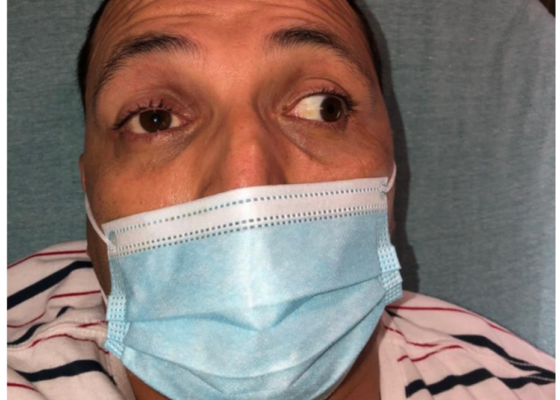
Point of care ultrasound (POCUS) revealed hyperechoic material in the vitreous consistent with a vitreous hemorrhage. On the ultrasound images, there is visible hyperechoic debris seen floating in the vitreous as the patient moves his eye. Since the vitreous is typically anechoic (black) in color on ultrasound, turning up the gain on the ultrasound machine makes these findings easier to see and often highlights abnormalities, such as this hemorrhage (see annotated still).
OphthalmologyUltrasoundVisual EM
Creative Commons images

Case Report of a Man with Right Eye Pain and Double Vision

Nicolas Kahl, MD* and Maria Pelucio, MD*

DOI: https://doi.org/10.21980/J8KW7G Issue 7:1[mrp_rating_result]
ABSTRACT: A 39-year-old previously healthy male presented with three days of right eye pressure and one day of binocular diplopia.  He denied history of trauma, headache, or other neurological complaints.  He had normal visual acuity, normal intraocular pressure, intact convergence, and no afferent pupillary defect. His neurologic examination was non-focal except for an inability to adduct the right eye past midline
OphthalmologyNeurologyVisual EM

Build Your Own Eye: A Method for Teaching Ocular Anatomy and Pathophysiology

Alaina Brinley Rajagopal, MD, PhD*, Mark Joseph Slader, BS* and Megan Boysen Osborn, MD, MHPE*

DOI: https://doi.org/10.21980/J8GS8W Issue 5:3[mrp_rating_result]
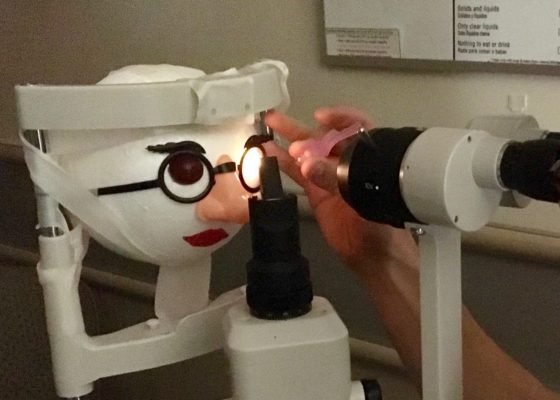
By the end of this session the participant will be able to: 1) Describe basic anatomy of the eye, 2) Build a basic model of the eye, 3) Identify which diseases are associated with which parts of the eye, 4) Identify the pathophysiology behind diseases of the eye, 5) Name correct treatment for each disease.
OphthalmologyTeam Based Learning (TBL)
Creative Commons images

The Eyes Have It: A Low-Cost Model for Corneal Foreign Body Removal Training

Tabitha Ford, MD*, Megan L Fix, MD*, Troy E Madsen, MD* and Susan Stroud, MD*

DOI: https://doi.org/10.21980/J82S85 Issue 5:1[mrp_rating_result]
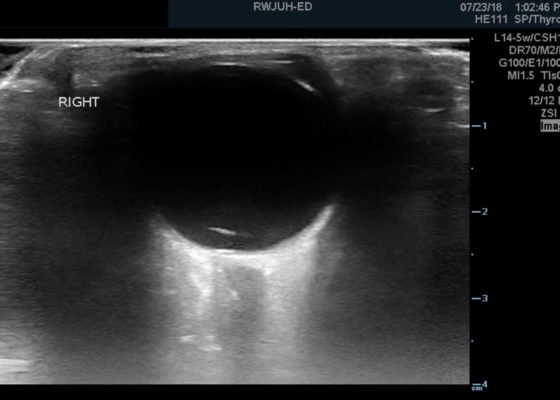
ABSTRACT: Audience: This corneal foreign body simulator is designed to instruct junior emergency medicine (EM) residents and medical students with an interest in emergency medicine. Introduction: Eye complaints are common in the emergency department (ED), accounting for approximately 2 million ED visits each year.1 Corneal foreign bodies (CFB) account for approximately 7.5% of these presentations, and many EM providers are
OphthalmologyInnovationsProcedures
Creative Commons images

Posterior Vitreous Detachment

Hamid Ehsani-Nia, DO* and Christopher Bryczkowski, MD*

DOI: https://doi.org/10.21980/J89K9N Issue 4:3[mrp_rating_result]
Ocular ultrasound was performed and demonstrated a thin, slightly echogenic strand (blue arrow) extending from the posterior eye into the vitreous humor (yellow arrow) which was hyperkinetic with extraocular motion. These findings are consistent with a posterior vitreous detachment (PVD).
OphthalmologyVisual EM
Creative Commons images

Macula-Off Retinal Detachment Identified on Bedside Ultrasound

Colin Prather, MD* and Bryson Hicks, MD*

DOI: https://doi.org/10.21980/J8WP8KIssue 4:2[mrp_rating_result]
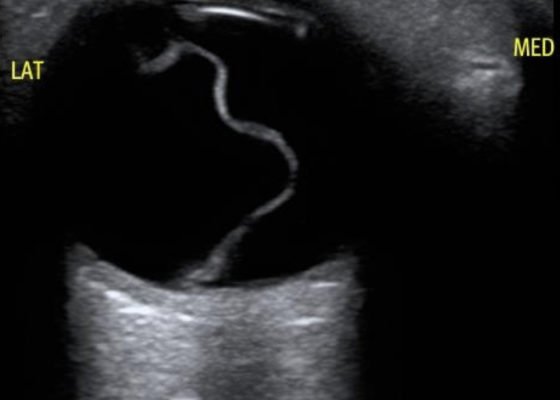
Point-of-care ultrasound was performed, demonstratinga free-floating, serpiginous, hyperechoic membrane (R) tethered at the optic nerve (ON) and ora serrata (OS), but detached at the macula (M) lateral to the optic nerve. This is diagnostic for macula-off retinal detachment. It can be differentiated from macula-on retinal detachment, in which the hyperechoic retina would appear attached posteriorly at the location of the macula just lateral to the optic nerve. Ophthalmology was consulted, agreed with the diagnosis of macula-off retinal detachment, and took the patient to the OR for laser photocoagulation.
OphthalmologyVisual EM
‹2›»
Page 2 of 4

JETem is an online, open access, peer-reviewed, journal-repository for EM educators. We are PMC Indexed.

Most Viewed

  • Enhancing Emergency Medicine Resident Education: A Weekly Education Series to Augment Electrocardiogram Education
  • Development and Design of a Pediatric Case-Based Virtual Escape Room on Acute Iron Toxicity
  • Pre-Clinical Case Competition to Assess Confidence in Responding to Select Out-Of-Hospital Medical Emergencies
  • Pediatric Difficult Airway Simulation Day
  • Cards Against Pulmonology

Visit Our Collaborators


Creative Commons Licence
This work is licensed under a Creative Commons Attribution 4.0 International License.

About

Education

Learners should benefit from active learning. JETem accepts submissions of team-based learning, small group learning, simulation, podcasts, lectures, innovations, curricula, question sets, and visualEM.

Scholarship

We believe educators should advance through the scholarship of their educational work. JETem gives educators the opportunity to publish scholarly academic work so that it may be widely distributed, thereby increasing the significance of their results.

Links

  • Home
  • Aim and Scope
  • Current Issue
  • For Reviewers
  • Instructions for Authors
  • Contact Us

Newsletter

Sign up to receive updates from JETem regarding newly published issues and findings.

Copyright Creative Commons Attribution 4.0 International