
Ob/Gyn

Clinical Decision-Making Case: Pediatric Sexually Transmitted Infections and Consent
DOI: https://doi.org/10.21980/J8.52335By the end of this case the learner will be able to: 1) demonstrate competency with the new ABEM Certifying Exam Clinical Decision-Making Case format, 2) manage a simulated pediatric care encounter that requires navigating the details of pediatric consent, 3) explain common exceptions to requiring parental consent in emergency situations according to established guidelines as well as state and local laws, 4) report increased comfort managing ethical dilemmas related to pediatric consent in the ED.
Clinical Decision-Making Case: Seizing the Diagnosis: Eclampsia
DOI: https://doi.org/10.21980/J8.52338By the end of this Mock Certifying Exam session, learners should be able to: 1) demonstrate familiarity with the Clinical Decision-Making case format and structure, 2) elicit relevant historical information and connect that information to the diagnosis of eclampsia, 3) describe and interpret physical exam findings and their significance in establishing a pertinent differential diagnosis, which includes eclampsia, 4) initiate appropriate diagnostic testing, interpret results accurately, and formulate a stabilization and treatment plan for a patient with eclamptic seizures, and 5) reassess the patient's condition, modify the management plan as needed, provide relevant anticipatory guidance for disposition, and articulate the clinical decision-making rationale at each stage of the encounter.
Prioritization: Run This Board: Septic Shock, Acute Coronary Syndrome, Small Bowel Obstruction, and Penetrating Chest Trauma
DOI: https://doi.org/10.21980/J8.52355By the end of this case learners will be able to: 1) Become familiar with format of a prioritization case (a component of the ABEM Certifying Exam), 2) Practice their ability to prioritize multiple patients and provide stabilizing care, 3) Consider changes in status/patient acuity/new cases as presented, 4) Understand how to utilize team resources appropriately.

The EMazing Race: A Novel Gamified Board and Clinical Practice Review for Emergency Medicine Residents
DOI: https://doi.org/10.21980/J8.52075By the end of this 2-hour session, learners will demonstrate their knowledge on the following board-related emergency medicine topics: Ob/GYN – links to 13.7 Complications of Delivery in Core Model of EM 2022, Renal/GU – links to 15.0 Renal and Urogenital Disorders in Core Model of EM 2022 and Splinting – links to 18.1.8.2 Extremity bony trauma, fracture in Core Model of EM 2022.

Critical Care Transport: Blunt Polytrauma in Pregnancy
DOI: https://doi.org/10.21980/J81366At the completion of this simulation participants will be able to 1) perform primary and secondary trauma surveys, 2) assess the neurovascular status of a tibia/fibula fracture, 3) appreciate anatomic and physiologic differences in pregnancy, 4) appropriately order analgesia and imaging, 5) recognize and treat hemorrhagic shock, 6) perform an extended focused assessment with sonography in trauma exam (eFAST) in undifferentiated hemorrhage, 7) identify a displaced pelvic fracture and properly apply a pelvic binder, and 8) obtain and interpret fetal heart rate using ultrasound.
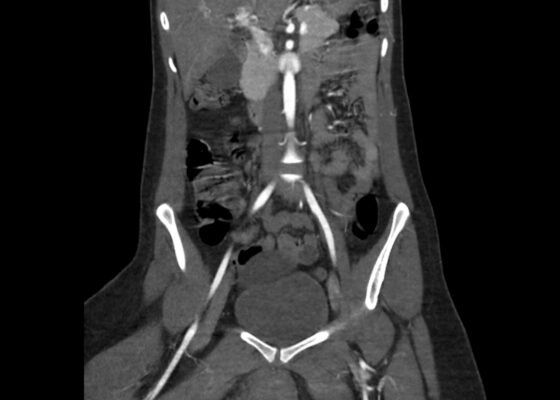

Computed Tomography Findings in Non-Obstetric Vulvar Hematoma: A Case Report
DOI: https://doi.org/10.21980/J8194HBedside ultrasound was first used to evaluate for evidence of abscess or cyst formation. Ultrasound demonstrated a hypoechoic area within the right labia without evidence of a cyst or abscess wall. Based on these findings, an angiogram CT of the pelvis was obtained which revealed a vulvar hematoma with evidence of active arterial extravasation. In both the coronal and axial view, there is an asymmetric area of isodensity in the right labia representing a hematoma (blue circled area). Angiography may show areas of active extravasation, which appears as hyperdensity within the area of hematoma (see red arrow in coronal plane).
High-Fidelity Simulation with Transvaginal Ultrasound in the Emergency Department
DOI: https://doi.org/10.21980/J8606QBy the end of the session, learners should be able to 1) recognize the clinical indications for transvaginal ultrasound in the ED, 2) practice the insertion, orientation, and sweeping motions used to perform a TVPOCUS study, 3) interpret transvaginal ultrasound images showing an IUP or alternative pathologies, and 4) understand proper barrier, disinfection, and storage techniques for endocavitary probes.