
JETem
  • Home
  • About
    • Aim and Scope
    • Our Team
    • Editorial Board
    • FAQ
  • Issues
    • Current Issue
    • Ahead of Print
    • Past Issues
  • Visual EM
    • Latest Visual EM
    • Search Visual EM
    • Thumbnail Library
  • For Authors
    • Instructions for Authors
    • Submit to JETem
    • Photo Consent
    • Policies
      • Peer Review Policy
      • Copyright Policy
      • Editorial Policy, Ethics and Responsibilities
      • Conflicts of Interest & Informed Consent
      • Open Access Policy
  • For Reviewers
    • Instructions for JETem Reviewers
    • Interested in Being a JETem Reviewer?
  • Topic
    • Abdominal/Gastroenterology
    • Administration
    • Board Review
    • Cardiology/Vascular
    • Certifying Exam Cases
      • Clinical Decision-Making
      • Prioritization
      • Communication
      • Procedure & Ultrasound
    • Clinical Informatics, Telehealth and Technology
    • Dermatology
    • EMS
    • Endocrine
    • ENT
    • Faculty Development
    • Genitourinary
    • Geriatrics
    • Hematology/Oncology
    • Infectious Disease
    • Miscellaneous (stats, etc)
    • Neurology
    • Ob/Gyn
    • Ophthalmology
    • Orthopedics
    • Pediatrics
    • Pharmacology
    • Procedures
    • Psychiatry
    • Renal/Electrolytes
    • Respiratory
    • Social Determinants of Health
    • Toxicology
    • Trauma
    • Ultrasound
    • Urology
    • Wellness
    • Wilderness
  • Modality
    • Certifying Exam Practice Cases
      • Clinical Care Cases
      • Communication & Procedural Cases
      • Old School Oral Board Cases
    • Curricula
    • Innovations
    • Lectures
    • Podcasts
    • Simulation
    • Small Group Learning
    • Team Based Learning (TBL)
    • Visual EM
  • Contact Us

Cardiology/Vascular

Enhancing Emergency Medicine Resident Education: A Weekly Education Series to Augment Electrocardiogram Education

Tyler West, MD*, Jarren Adam, DO^ and Kevin Watkins, MD*

DOI: https://doi.org/10.21980/J8.52141 Issue 11:1[mrp_rating_result]
The goals of the curriculum were to establish an asynchronous ECG curriculum to help improve standardization of EM resident education, expose EM residents to a more comprehensive ECG curriculum, increase active learning in this arena, and decrease the administrative burden while not dedicating further conference time towards ECG education. 
Current IssueCardiology/VascularCurricula
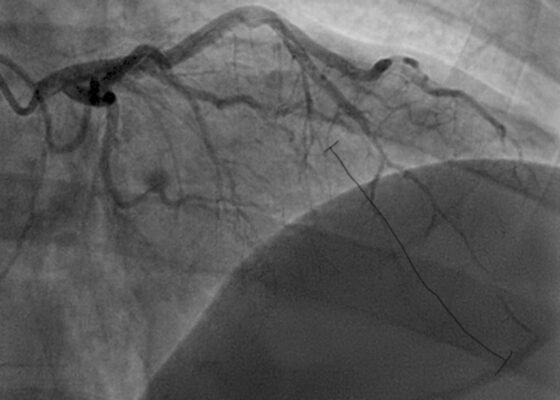
SCAD. Angiography. JETem 2026

A Case Report of a 36-year-old Male Diagnosed with a Spontaneous Coronary Artery Dissection

Stephen DeWitt, DO*, Jacob McClinton, MD* and Daniel Jarrell, DO*

DOI: https://doi.org/10.5070/M5.52022Issue 11:1[mrp_rating_result]
The initial ECG obtained from the patient shows subtle ST-segment elevation noted in leads I, aVL, and V2-V5, suggestive of pathology of the left anterior descending artery. The results of the catheterization revealed a spontaneous coronary artery dissection of the distal portion of the left anterior descending coronary artery, which can be seen in the image of the angiogram, with the diseased portion notated between the brackets.
Visual EMCardiology/VascularCurrent Issue
Edema Bulla. Photo 1. JETem 2026

Effects of Volume Overload: A Case Report of an Edema Bulla

Jarom Morris*, Matthew Sommer*, Felix Braun, MD*, Brent Klapthor, MD*, Allison Beaulieu, MD, MAEd* and Megan Fix, MD*

DOI: https://doi.org/10.5070/M5.52206 Issue 11:1[mrp_rating_result]
This image shows a large edema bulla on the patient's right shin. The bulla is 10 x 10 cm, filled with serous fluid, has a spontaneously occurring defect in the skin of the superior portion of the bulla, and is non-erythematous. The bulla is much larger than the 1-5 cm edema bullae described in the literature. As edema bulla is primarily a clinical diagnosis, taking the full history and physical exam into account is essential to recognize these bullae.
Visual EMCardiology/VascularCurrent IssueDermatology

Reassessment Case: Acute Pulmonary Edema in a Boarding Patient

Tina H Chen, MD1, David Fernandez, MD2, Amrita Vempati, MD3, Kelly Roszczynialski, MD, MS4, Stephanie Cohen, DO5, Charles Lei, MD6, Hillary Moss, MD7, Tiffany Moadel, MD8, Stephanie Stapleton, MD9 and Lars K Beattie, MD10

DOI: https://doi.org/10.21980/J8.52353 Issue 10:5[mrp_rating_result]
By the end of the case, the learner should will be able to:  1) demonstrate competency with the new ABEM Certifying Exam Reassessment case format, 2) demonstrate the ability to evaluate new information and integrate it into an existing care plan, 3) recognize signs and symptoms of pulmonary edema, 4) review possible etiologies of acute respiratory distress and the evaluation/work up to differentiate and diagnose those causes, and 5) manage pulmonary edema including implementing afterload reduction, positive pressure ventilation, and diuresis.
Board ReviewCardiology/VascularCertifying Exam CasesCommunication

Ultrasound Case: Syncope in PE

Neil Wallace, MD1, Andrew Melendez, DO2, Lars K Beattie, MD3, Tina H Chen, MD4, David Fernandez, MD5, Amrita Vempati, MD6, Kelly Roszczynialski, MD, MS7, Stephanie Cohen, DO8 Stephanie Stapleton, MD9 and Tiffany Moadel, MD10

DOI: https://doi.org/10.21980/J8.52365Issue 10:5[mrp_rating_result]
By the end of the session, learners will be able to: 1) obtain and interpret the parasternal short-axis view of the heart to assess right ventricular size and function, 2) identify ultrasound findings suggestive of pulmonary embolism (PE) on cardiac short-axis view, including right ventricular dilation and septal bowing, 3) demonstrate appropriate probe selection and positioning to obtain optimal images of the heart and inferior vena cava (IVC), 4) evaluate the IVC using a subxiphoid or longitudinal view to assess distension and lack of respiratory collapse as supportive findings for elevated right heart pressures, 5) identify the anatomy of the neck vasculature, differentiate between the internal jugular vein and carotid artery, and select the appropriate puncture site, 6) describe ultrasound-guided central venous catheterization via the right internal jugular vein, using a sterile technique and real-time guidance
Board ReviewCardiology/VascularProcedure & UltrasoundUltrasound

Clinical Decision-Making Case: Pulmonary Embolism

James H Lee, MD* and Linda Herman, MD*

DOI: https://doi.org/10.21980/J8.52339 Issue 10:5[mrp_rating_result]
By the end of the clinical decision-making case, the learner will: 1) gain familiarity with clinical decision-making (CDM) case format to be used in the new American Board of Emergency Medicine (ABEM) certification examination starting in 2026, 2) demonstrate the ability to obtain a focused history and physical examination and develop appropriate differential diagnoses for chest pain and dyspnea, 3) demonstrate understanding of clinical decisions rules to estimate the pre-test probability for pulmonary embolism and the application of rules to guide appropriate diagnostic testing, 4) recognize high clinical suspicion for pulmonary embolism and indication for empirical treatment, 5) recognize the unstable patient and provide appropriate hemodynamic and respiratory support, 6) understand indications for thrombolytic therapy or embolectomy in unstable pulmonary embolism, 7) demonstrate communication skills with patients and specialists across the health care spectrum, and 8) arrange appropriate disposition for the unstable patient with a pulmonary embolism.
Board ReviewCardiology/VascularCertifying Exam CasesClinical Decision-Making

Prioritization: Run This Board: Septic Shock, Acute Coronary Syndrome, Small Bowel Obstruction, and Penetrating Chest Trauma

Colleen Donovan, MD1, Nicole Novotny, MD2, Charles Lei, MD3, Alaa Aldalati, MBBS4, Andrew Melendez, DO5, Neil Wallace, MD6, Tiffany Moadel, MD7, Stephanie Stapleton, MD8 and Shagun Berry, DO9

DOI: https://doi.org/10.21980/J8.52355 Issue 10:5[mrp_rating_result]
By the end of this case learners will be able to: 1) Become familiar with format of a prioritization case (a component of the ABEM Certifying Exam), 2) Practice their ability to prioritize multiple patients and provide stabilizing care, 3) Consider changes in status/patient acuity/new cases as presented, 4) Understand how to utilize team resources appropriately.
Abdominal/GastroenterologyBoard ReviewCardiology/VascularCertifying Exam CasesInfectious DiseaseNeurologyOb/GynPediatricsPrioritizationTrauma

Myopericarditis and Pulmonary Edema

Lubna Ahmad Saffarini, MBBS*^

DOI: https://doi.org/10.21980/J8.52187 Issue 10:4[mrp_rating_result]
At the end of this oral board session, learners will be able to: 1) Demonstrate the ability to evaluate and treat a somnolent and hypoxic patient, 2) Identify a critical airway situation and manage it with a holistic approach, 3) Interpret the history, physical examination, ECG, and chest x-ray findings and discuss the list of differential diagnoses, 4) Identify a state of cardiogenic shock induced by myopericarditis and treat it appropriately, 5) Assess the presence of pericardial effusion and cardiac tamponade utilizing bedside echocardiography.
Current IssueCardiology/VascularCertifying Exam Cases
1›»
Page 1 of 14

JETem is an online, open access, peer-reviewed, journal-repository for EM educators. We are PMC Indexed.

Most Viewed

  • Enhancing Emergency Medicine Resident Education: A Weekly Education Series to Augment Electrocardiogram Education
  • Development and Design of a Pediatric Case-Based Virtual Escape Room on Acute Iron Toxicity
  • Pre-Clinical Case Competition to Assess Confidence in Responding to Select Out-Of-Hospital Medical Emergencies
  • Pediatric Difficult Airway Simulation Day
  • Cards Against Pulmonology

Visit Our Collaborators


Creative Commons Licence
This work is licensed under a Creative Commons Attribution 4.0 International License.

About

Education

Learners should benefit from active learning. JETem accepts submissions of team-based learning, small group learning, simulation, podcasts, lectures, innovations, curricula, question sets, and visualEM.

Scholarship

We believe educators should advance through the scholarship of their educational work. JETem gives educators the opportunity to publish scholarly academic work so that it may be widely distributed, thereby increasing the significance of their results.

Links

  • Home
  • Aim and Scope
  • Current Issue
  • For Reviewers
  • Instructions for Authors
  • Contact Us

Newsletter

Sign up to receive updates from JETem regarding newly published issues and findings.

Copyright Creative Commons Attribution 4.0 International